 Pancakeswap
 Liquidity Pools Convert Deposits Into Positions You Can Partially or Fully Redeem
Pancakeswap Liquidity Pools accept assets for a chosen token pair and create a position that represents the depositor's share or configured range. Adding liquidity commits tokens to the pool, while removing liquidity redeems some or all of the position for underlying assets in the ratio available at execution. Swap fees may increase the position's value, but the pool state at execution still determines the returned token amounts.
The important choices come before wallet confirmation: the network, token identities, pool version and, for V3, the fee tier and price range. Those settings determine what can be deposited, when capital is active and what the position returns later.
Deposits become a claim on pool reserves
A liquidity deposit changes the pool's reserves and creates an ownership record. The pool then uses its reserves for swaps, collecting fees under its configured rules. A position therefore isn't a static balance of the tokens originally supplied. It represents a claim governed by the pool version, the position's settings and the reserve state when liquidity leaves.
An established V2 pool accepts assets in the ratio implied by its reserves and issues fungible LP tokens. V3 instead associates liquidity with a selected price interval. In both cases, later swaps can change the quantities of each underlying token represented by the position, even when the depositor hasn't adjusted it.
Pair, version and range define the position
A position belongs to one token pair on one supported network. Two assets with familiar names can still have different identifiers, so the selected contract address, mint address or other network identifier matters. A position created for one pair, version or network can't satisfy a deposit intended for another. Infinity adds another version check. Its CLAMM pools use ranged NFT positions, LBAMM assigns fungible liquidity to discrete price bins and Infinity StableSwap keeps liquidity active across its full curve without a range. Classic StableSwap follows its own pool model. Infinity hooks can change fees or liquidity actions, so check the pool type and attached hook before choosing assets, ranges or approvals.
Pair and network identity
The wallet network must match the pool's deployment before any approval or deposit can work. The wallet also needs the correct assets and enough of the network's fee-paying token. Checking identifiers before signing prevents a copied ticker or unrelated token from becoming part of the position.
V2 and V3 ownership records
V2 mints fungible LP tokens that represent a proportional pool share. V3 creates a non-fungible position with its own pair, fee tier and price boundaries. Adding funds to an existing V3 position preserves those settings. A different range or fee tier requires a separate position rather than an edit to the original boundaries.
V3 price boundaries
A V3 range sets the prices at which the position supplies active liquidity. A range crossing the current pool price normally calls for both assets. A range entirely to one side can require only one asset, with the applicable token determined by the price direction. The interface's quoted deposit amounts should reflect that relationship before signing.
Deposit amounts follow the pool configuration
An established pool determines the usable relationship between the two deposit amounts. Entering one amount lets the interface calculate the other when both assets are required. The smaller available side can limit the completed deposit. Changing a V3 range also changes the necessary token mix because a narrower or shifted interval covers different prices.
Allowances and transaction authority
An EVM token may require an approval before the liquidity contract can transfer it. Approval creates an allowance; it doesn't deposit the asset or create a position. A pair of ERC-20 tokens may therefore need two approvals, while a native asset follows a different path. Other network families use their own authorization model, so an EVM approval sequence shouldn't be assumed elsewhere.
Position preview and compatibility
The preview should identify the pair, version, fee tier and range that the wallet will act on. It should also show the proposed token amounts. Compatibility is the limiting condition: the token standard and behavior must be supported by the chosen pool version. On EVM, PancakeSwap V3 doesn't support fee-on-transfer or rebase tokens, and a larger allowance or looser price range won't make them compatible. The selected network and asset identifiers must match the intended pool.
A successful deposit creates or increases the intended position and changes the wallet balances. An approval without a later deposit leaves only the allowance. Likewise, a failed deposit doesn't establish ownership merely because the interface prepared a preview.
Active range controls V3 fee earning
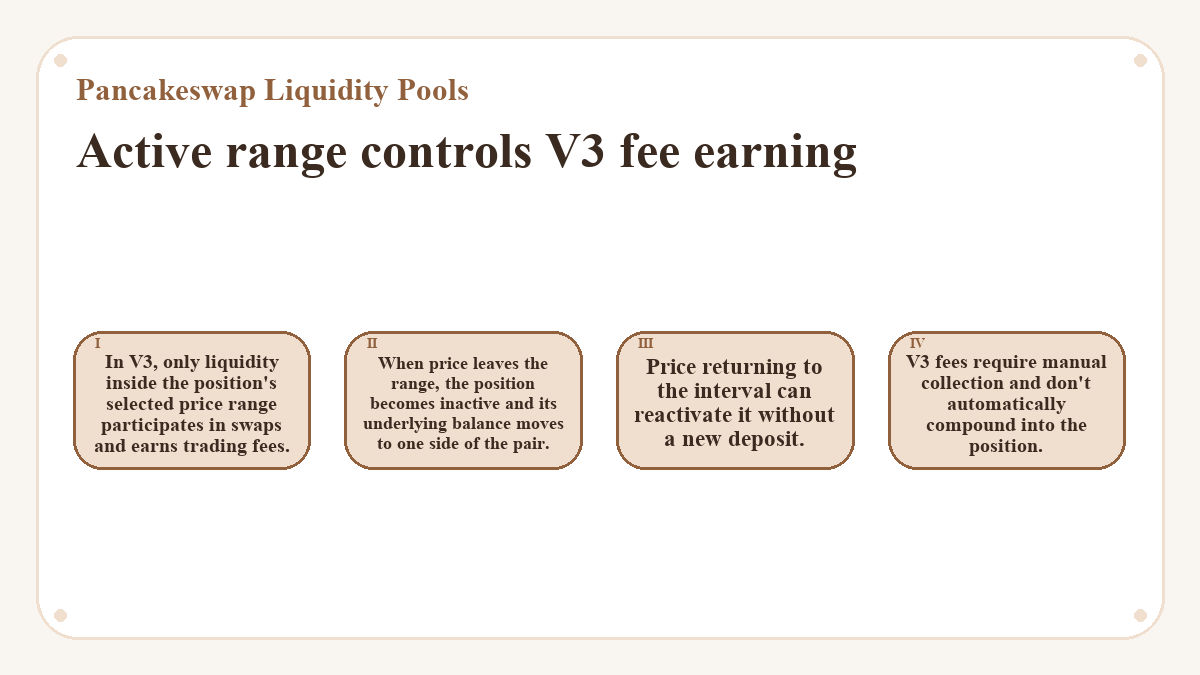
In V3, only liquidity inside the position's selected price range participates in swaps and earns trading fees. When price leaves the range, the position becomes inactive and its underlying balance moves to one side of the pair. Price returning to the interval can reactivate it without a new deposit. V3 fees require manual collection and don't automatically compound into the position.
Removal returns the current token mix
A withdrawal converts position liquidity back into one or both underlying assets at the pool's current state. It doesn't reverse the original deposit. Swaps, fees and relative price changes can leave the position holding a different mix, while an out-of-range V3 position may consist entirely of one token. The removal preview provides the relevant estimate for that transaction.
Partial and complete withdrawal
A partial removal returns assets for the selected portion and leaves the remaining liquidity in place. Its future fee activity still depends on the pool version and, for V3, whether the remaining position stays in range. A complete removal withdraws all redeemable liquidity, although an empty position record can remain until the applicable interface offers and completes a separate close action.
Current composition and impermanent loss
The difference between a liquidity position and simply holding the deposited assets is commonly called impermanent loss. The comparison changes as relative prices move. Removing liquidity fixes the quantities received at that point, so the word “impermanent” doesn't promise recovery. Trading fees may offset part of that difference, but no fee amount or positive outcome is assured.
Position actions and their boundaries
| Position action | Boundary or observable result |
|---|---|
| Create a V3 position | Creates distinct pair, fee tier and price-range settings. |
| Increase a V3 position | Adds assets without changing its existing range or fee tier. |
| Add V2 liquidity | Uses the established pool ratio and mints fungible LP tokens. |
| Remove part of a position | Returns the selected share while leaving reduced liquidity behind. |
| Remove all liquidity | Returns the assets represented by all remaining liquidity; an empty position record may remain. |
Changing a V3 range isn't an increase operation. It requires withdrawing liquidity and creating a position with new boundaries. That distinction prevents an added deposit from being mistaken for a range adjustment.
Confirmation appears in balances and position records
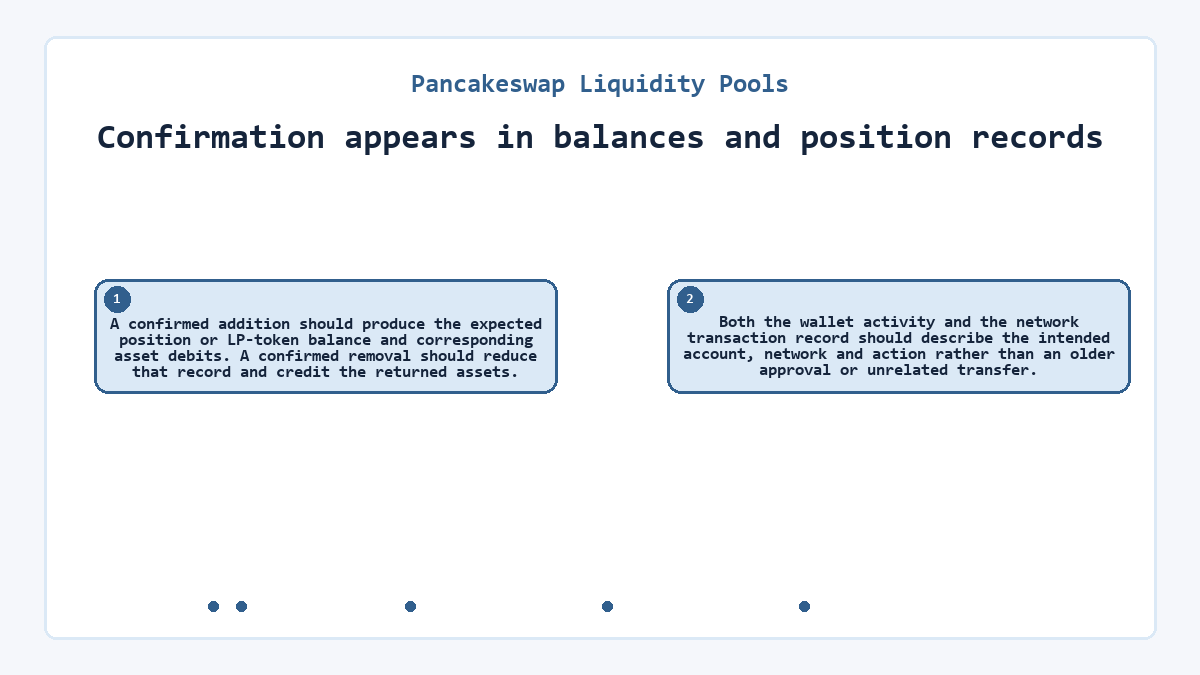
A confirmed addition should produce the expected position or LP-token balance and corresponding asset debits. A confirmed removal should reduce that record and credit the returned assets. Both the wallet activity and the network transaction record should describe the intended account, network and action rather than an older approval or unrelated transfer.
Network fees apply to transactions such as approvals, deposits and withdrawals. A transaction can also fail after submission if its minimum-amount protection or deadline no longer matches execution conditions. A reverted transaction doesn't change the liquidity position, though the network may still charge for the computation it processed.
Fresh balances and the updated position record provide the completion evidence. If the wallet remains on the wrong network, an identifier doesn't match or the pool state moves beyond the transaction's limits, the expected position change won't occur. Those conditions require a corrected or refreshed request, not an assumption that the earlier preview completed the task.
Everyday questions about Pancakeswap Liquidity Pools
Can V3 fees be collected without removing liquidity?
Yes. V3 trading fees can be claimed from the position detail view without withdrawing the underlying liquidity. Claiming transfers accrued fees but doesn't change the position's selected pair, fee tier or price range. Those fees don't automatically compound into V3 liquidity, so adding them back requires another deposit transaction and any authorization that transaction needs.
Why is the add button unavailable after I enter a deposit amount?
The wallet may lack a required asset balance or token authorization. Check both asset balances, the network's fee-paying asset and the selected wallet network. For V3, the chosen range also determines whether the deposit needs one token or both. An incompatible token, pool version or network won't become usable by raising the amount or repeating an approval.
Is a token approval the same as adding liquidity?
No. An EVM token approval authorizes a specified contract to transfer up to an allowed amount; it doesn't move tokens into a pool or create liquidity. The deposit requires a later transaction. If only the approval confirms, the wallet retains the tokens and the allowance remains available until it is spent, changed or revoked.
Which asset pays the network cost for adding or removing liquidity?
The selected network's native fee asset pays the transaction cost, even when neither deposited token is that asset. The wallet must retain enough of it for every required approval, deposit or withdrawal transaction. Pool assets cover the liquidity contribution itself, while network fees compensate validators or other network processors and don't become part of the position.
Does transferring a V3 position also transfer control of its deposited assets?
Yes. A V3 position uses a transferable non-fungible token that represents ownership of its underlying liquidity and associated fees. Sending that position token changes who controls withdrawal and fee collection for the position. Because the token carries control of the position, verify the receiving address and network as carefully as you would for any asset transfer.
Updated: