 Pancakeswap
 Swap Routes and Result Verification
Pancakeswap compares available liquidity paths before building a wallet transaction for a token swap. Its router can use a direct pool, connect pools through intermediate tokens, divide an order across paths or route through supported market makers. The quote should show the expected output after applicable trading fees and price impact, along with the route's execution constraints.
Route selection is only the first checkpoint. The wallet request, onchain receipt and final balance show whether the quoted state became a completed trade, while liquidity positions require a different set of checks.
Compare the full route, minimum output and onchain receipt before treating a Pancakeswap quote as a completed token swap.
Swaps, liquidity and route selection
On supported networks, Pancakeswap can route token swaps through automated liquidity pools or market makers. Each pool holds paired assets and applies its own pricing curve and fee configuration. A pool-based route may use one pool or several connected pools. The router compares the available paths for the selected input size because the deepest pool, shortest path and lowest fee tier don't always produce the same output.
Liquidity providers deposit assets into pools and receive positions that represent their share under each pool's rules. They may collect trading fees, but they also accept price-range exposure or impermanent loss. Other trading and earning tools can use different contracts, so a spot-swap quote shouldn't be treated as evidence about every Pancakeswap product.
Identity and wallet boundaries
Identity checks begin with the selected network and the token's contract address, mint address or asset identifier because a ticker or logo can be copied. A basic wallet connection lets the interface read public wallet data, but it doesn't itself create a token allowance. When approval is required, its authorization is distinct from the swap instruction. The spender named in an approval should match the authorization contract expected by the reviewed trade, and the wallet should display the expected network. Any prompt asking for a seed phrase or private key is unrelated to a legitimate swap. Pancakeswap doesn't need either secret to prepare the transaction.
From quote to confirmed balance
A standard exact-input swap starts with a chosen network, input token, output token and spending amount. The interface calculates an estimated output and a route from the pool state available at that moment. The user then reviews the route, minimum received amount, price impact, pool fees and estimated network cost before signing anything.
An EVM token may need an approval transaction before the swap transaction. Once the swap is signed, the wallet broadcasts it to the selected network. A pending status means execution remains unresolved. A successful receipt records execution, but the final check is the actual output-token balance and the transfers recorded for the same wallet.
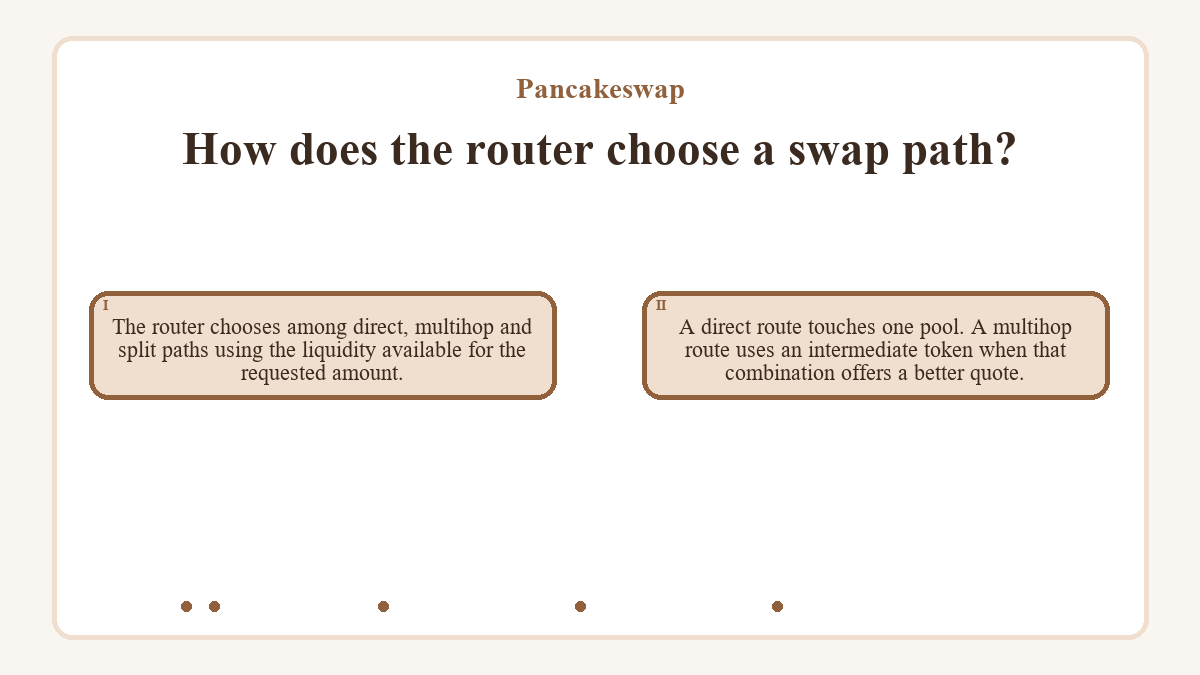
How does the router choose a swap path?
The router chooses among direct, multihop and split paths using the liquidity available for the requested amount. A direct route touches one pool. A multihop route uses an intermediate token when that combination offers a better quote.
The Smart Router can send portions of one input through multiple routes in a single swap plan.
Route settings can restrict the liquidity sources, multihop behavior or split routing that the engine may use. Those restrictions can make a quote easier to inspect, but they can also remove a stronger path. Compare the expected output under the same input amount and slippage rules. A shorter route isn't automatically cheaper if its pool has less usable liquidity.
Reading the quote before signing
A quote needs enough detail to identify both the intended exchange and its execution limits. The visible rate alone can't show how the transaction reaches its output. Review the fields together:
- The selected network and both token identifiers
- The exact input or requested output amount
- The estimated output and minimum received amount for exact input or the maximum input for exact output
- The price impact, pool fees and complete route
- The network cost estimate and approval status
Price impact describes how the requested size affects the pool-based quote. Slippage tolerance sets the permitted deterioration between quoting and execution. For an exact-input swap, the minimum received value turns that tolerance into an enforceable output boundary. Refreshing the quote matters after a delay because pool balances, competing trades and network conditions can change before a signature reaches the chain.
What changes the final swap cost?
Final swap cost comes from applicable trading fees, execution price impact, the network transaction fee and any token-level transfer mechanics that apply. Each hop can add a pool fee, while shallow usable liquidity can worsen the execution price for a larger input. The network transaction fee remains separate from the trading fee and varies with the transaction. Slippage tolerance isn't a charge; it defines how much adverse movement the transaction may accept. A wider tolerance may reduce quote-related failures, but it permits a lower output for an exact-input swap or a higher input for an exact-output swap.
A normal route and a recovery boundary
All token amounts, quoted outputs, tolerance boundaries, route states and receipt states in this example are hypothetical. They aren't live, typical or recommended values. A reader enters 137 units of a source token and receives a quote for 52.47 units of a destination token, with 52.17 shown as the minimum output.
In the normal state, the reviewed route remains available when the transaction executes. The receipt succeeds and the destination-token balance increases by 52.31 units. That increase exceeds the hypothetical minimum, so the quote, receipt and observed balance reconcile without another transaction.
In the edge state, the same hypothetical input reaches the network after the usable route changes beyond the allowed boundary. The receipt shows a revert, the destination balance doesn't increase and the network fee may still be spent. The recovery boundary is the failed receipt: refresh the route and inspect the new minimum before considering another signature.
A transaction that remains pending hasn't crossed that boundary. Repeating it can create competing wallet requests, so the next action is to inspect the existing transaction rather than assume failure. Changing the input size, available liquidity or route fees would change the next quote and its minimum output.
Allowances and transaction signatures
An allowance authorizes a named contract to spend up to a stated quantity of an EVM token. It doesn't perform the swap. The approval may remain active after execution, depending on its amount and how much the swap consumed. Reviewing the spender and allowance limit helps distinguish permission from the later exchange instruction.
A swap signature contains the actionable terms, including token identifiers, trade amounts, slippage protection and a validity boundary. Reject the request if those fields don't match the quote under review. Disconnecting a wallet from a website doesn't revoke an onchain allowance; revocation requires a separate onchain action on the network where the approval exists.
How can a completed swap be verified?
A successful onchain receipt is the primary execution record, and the wallet balance confirms the usable result. Match the receipt to the intended wallet and network, then check its success status, token transfers and actual destination amount. The observed amount should respect the signed minimum for an exact-input swap. If the receipt succeeds but the wallet interface shows no new asset, confirm the destination token identifier and check whether the wallet has hidden that token rather than submitting the swap again.
Failure states and reconciliation
A pending transaction still awaits confirmation or rejection. Check the existing transaction identifier before creating a replacement; on an EVM network, also check the wallet nonce. Network congestion, a low gas setting or a dropped broadcast can delay the visible outcome without proving that the swap failed.
A failed receipt ends that attempt. Common causes include movement beyond the output boundary, an out-of-gas execution, an expired instruction, missing allowance, unavailable liquidity or token transfer restrictions. Refreshing the same page without reading the receipt can hide which condition changed.
A successful receipt with an unexpected display needs a different response. Inspect the recorded transfers, destination token identifier and wallet token list. An onchain success shouldn't be repeated merely because a portfolio view hasn't refreshed.
Liquidity positions and exit decisions
Liquidity provision isn't a swap with a fixed destination amount. A provider deposits assets under a pool's rules and receives a position. On supported EVM deployments, V2 positions use fungible liquidity-provider tokens, while V3 positions use non-fungible positions with chosen price ranges. The router can draw from these pools, but the provider's outcome depends on trading activity and the position configuration.
A V3 liquidity position earns trading fees only while its selected price range contains the active market price.
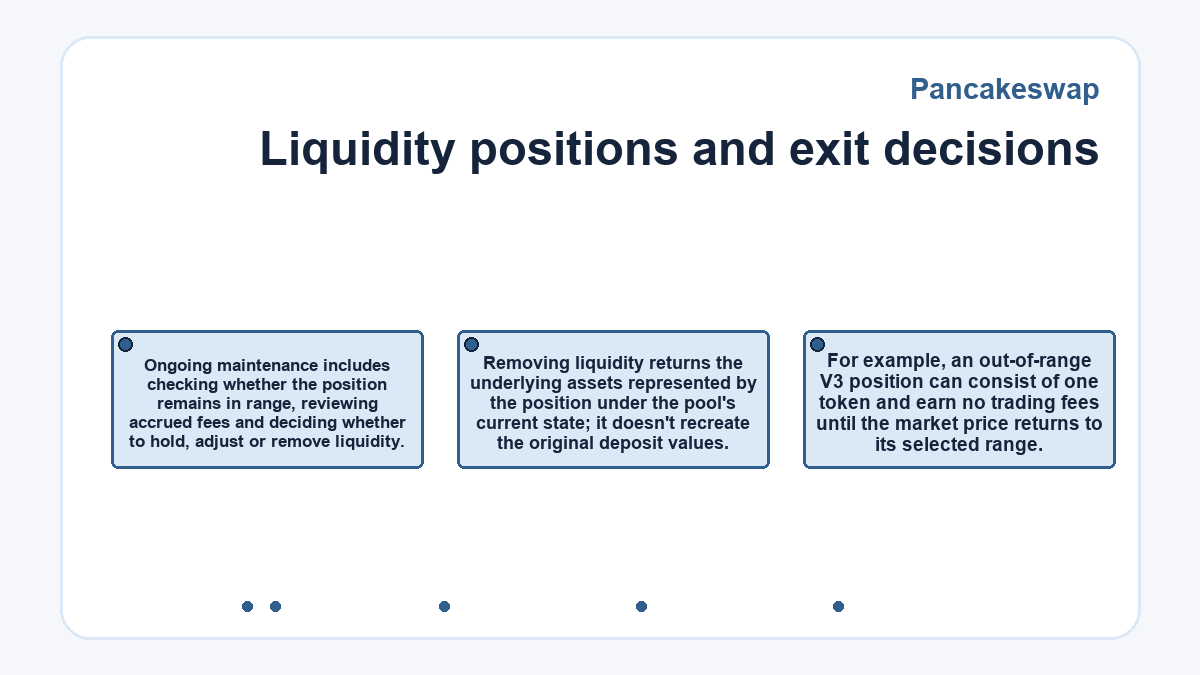
Ongoing maintenance includes checking whether the position remains in range, reviewing accrued fees and deciding whether to hold, adjust or remove liquidity. Removing liquidity returns the underlying assets represented by the position under the pool's current state; it doesn't recreate the original deposit values. For example, an out-of-range V3 position can consist of one token and earn no trading fees until the market price returns to its selected range.
What to know about Pancakeswap
Can Pancakeswap swap tokens between different networks?
Yes, when its crosschain swap feature supports the source network, destination network, selected tokens and available liquidity. That route includes more than a normal single-chain exchange because assets must move through a bridging stage and may require execution on both sides. Review every quoted fee and destination amount, then verify the source transaction, bridge state and destination balance separately.
Which token pays the network fee for a swap?
The selected network's native asset pays the network fee. The input token doesn't replace that requirement unless it is also the network's native asset in the form expected by the wallet. Keep enough of that asset for any required approval and the swap itself, since each onchain action may create a separate network charge.
Is CAKE required for a Pancakeswap token swap?
No, CAKE isn't required for an ordinary token swap; you need the input token, enough of the selected network's native asset to pay gas and a compatible wallet, while the available route still depends on liquidity for the chosen token pair and any transfer rules attached to those tokens.
Can a confirmed Pancakeswap swap be reversed?
No, a confirmed onchain swap can't be reversed through the exchange interface. If the received token has a viable return route, a user may submit a new swap in the opposite direction, but that is a separate trade with a fresh quote, new fees and new execution risk. An incorrect token or network choice isn't converted into a reversible card-style payment.
What happens if a Pancakeswap swap passes its transaction deadline?
An expired deadline prevents that swap instruction from executing under its original terms. If it hasn't been submitted, refresh the quote and review a new transaction. If the network includes it after the deadline, it can revert and still consume a network fee. The deadline doesn't reserve a price or liquidity, and another attempt requires a new quote and signature.
Updated: